Klobuchar Announces for Governor

Wednesday, February 4, 2026

Governor

Minnesota Democratic Sen. Amy Klobuchar

As expected, Democratic Sen. Amy Klobuchar has now officially entered the open Minnesota gubernatorial campaign with her announcement late last week.

Previously, she filed a gubernatorial campaign committee as a prelude to her formal declaration. Just re-elected to the Senate in 2024, Klobuchar does not have to risk her Senate seat to run for Governor.

It appears the four-term Senator and former Hennepin County Attorney is a lock for the Democratic nomination and will likely become the official party nominee at the state Democratic endorsing convention to be scheduled well before Minnesota’s Aug. 11 primary election. She will also be favored in the general election, but it remains to be seen what type of effort the Republicans will launch now that the race has drastically changed since incumbent Gov. Tim Walz (D) surprisingly ended his quest for a third term.

In all likelihood, Sen. Klobuchar will win the Governor’s race and then appoint her own successor to the US Senate. If this happens, the appointed Senator will have the opportunity of running to fill the balance of the term in 2028 and would be eligible to seek a full six-year term in 2030.

Klobuchar is the fourth Senator this year running for Governor in their respective state. Sens. Tommy Tuberville (R-AL), Michael Bennet (D-CO), and Marsha Blackburn (R-TN) have also launched gubernatorial campaigns.

Tuberville is the only in-cycle Senator, however, as he risks his seat to run for Governor. His move looks to pay political dividends. Candidate filing has closed in Alabama, and he faces only minor opposition in the Republican primary. Only insurance agent Ken McFeeters and civic center manager Will Santivasci are competing against him for the party nomination in the May 19 primary.

After being nominated, Sen. Tuberville is likely to square off against former US Sen. Doug Jones who is in equally strong position to win the Democratic nomination. The general election will be a rematch of the 2020 Senate race, a campaign that Tuberville won easily, 60.1 – 39.7 percent.

The Senate election to replace Tuberville will likely be decided in the Republican nomination process. The principal contenders are Attorney General Steve Marshall, Rep. Barry Moore (R-Enterprise), retired Navy SEAL and anti-human trafficking activist Jared Hudson, and former Trump White House aide Morgan Murphy. Early polling favors AG Marshall, but President Trump has now endorsed Rep. Moore.

The Colorado race has produced at least one surprise. It appears that Sen. Bennet will have a fight on his hands in the Democratic primary against term-limited Attorney General Phil Weiser. According to the latest state financial disclosure report, AG Weiser has raised more in the way of campaign funds than Sen. Bennet. The numbers find Weiser accumulating $4.6 million in 2025 versus $3.5 million for his major opponent. Weiser also reported a $3.4 to $1.6 million cash-on-hand advantage.

There has only been one published poll of the Democratic race, which was released last June from the Global Strategy Group, a well-known Democratic professional polling firm. The ballot test found Sen. Bennet opening with a healthy 53-22 percent lead.

The winner of the state’s June 30 primary election will become a prohibitive favorite to clinch the general election and succeed term-limited Gov. Jared Polis (D).

The Tennessee gubernatorial campaign is also likely to be decided in the party primary, but this time on the Republican side. Sen. Blackburn’s principal opponent is Rep. John Rose (R-Cookeville), and Blackburn is a heavy favorite to win the party nomination and the general election.

Sen. Blackburn has dominated the early polls. The most recent release came in late October from Targoz Market Research and projected Sen. Blackburn with a 58-9 percent landslide advantage over Rep. Rose. Large margins have also been present in the three other publicly released polls earlier in the year.

Assuming all four Senators win their race, three of them will likely choose their own successor unless the outgoing Governor makes the Senate appointment as he is leaving office.

Rumors suggest that in two of the three cases the outgoing Governor, himself, Polis in Colorado and Walz in Minnesota, could become the appointed Senator. Therefore, the four Senators running for Governor will also produce post-election political drama just as 2027 begins.

The Michigan Barnburner


By Jim Ellis — Tuesday, February 3, 2026

Senate

A new Emerson College poll of the Michigan Senate race again suggests that we will see another photo finish in the 2026 campaign.

The latest EC poll (Jan. 24-25; 1,000 likely Michigan voters; 491 likely Democratic primary voters; multiple sampling techniques) sees a change in both the Democratic primary and the general election.

For the first time, Emerson projects state Sen. Mallory McMorrow (D-Royal Oak) taking the lead over Rep. Haley Stevens (D-Birmingham) and former Wayne County Health Director Abdul El-Sayed in the party primary. According to the Emerson ballot test result, Sen. McMorrow posts a 22-17-16 percent advantage over Rep. Stevens and Dr. El-Sayed.

This is the first poll that found someone other than Rep. Stevens holding the Democratic lead, though three of the other five polls released since early May have detected all three candidates polling under 30 percent support. Therefore, despite the projected change at the leader level, this race remains a tight, three-way toss-up.

The Michigan Senate seat is open because two-term incumbent Sen. Gary Peters (D) chose not to seek a third term. He likely would have been favored for re-election.

The general election polling is equally close. Likely Republican nominee Mike Rogers, the former Congressman who came within three-tenths of a percentage point of upsetting current Sen. Elissa Slotkin (D) in the 2024 general election, will be a formidable November contender. He has led all three of the Democratic candidates at one time or another in early polling. Rogers slightly trails Rep. Stevens in most polls but leads Sen. McMorrow and Dr. El-Sayed in almost all isolated pairings.

In the latest Emerson poll, Rep. Stevens tops Rogers, 47-42 percent, and Sen. McMorrow would lead him 46-43 percent, while El-Sayed and Rogers are tied at 43 percent support.

It is interesting to see the general election sample finding Stevens further ahead of Rogers than McMorrow in the same poll where the Democratic segment favored the latter contender. This means that Rep. Stevens is attracting a better share of the non-affiliated vote than is Sen. McMorrow when paired individually with the Republican former Congressman.

Looking at the 2024 polling, we again see a Republican underpoll when compared to the final result. Such a pattern has been present in a number of states and was certainly the case in President Trump’s three elections.

In the Michigan ’24 Senate contest, 82 public polls were released after the August primary. In those, Rogers led in only three. While he didn’t win the race, he clearly performed better than projected.

Of the four organizations that tracked polling in the 2024 election, Real Clear Politics, the Five-Thirty-Eight data organization, which is no longer in existence, 270 to Win, and Decision Desk Headquarters, all found Slotkin leading by a larger margin than her actual victory percentage. Such was true regardless of whether all the post-primary polls were included or just those from late October to Election Day.

The Slotkin average lead ranged from a high of 4.1 to a low of 2.3 percentage points, remembering that her victory spread was just 0.3. In terms of raw numbers, Sen. Slotkin won the race by only 19,006 votes from more than 5.58 million ballots cast.

Therefore, if we surmise that a similar pattern might occur in 2026, then this race is likely to be decided by just a few votes irrespective of which Democrat wins the party nomination. The political climate at the time of the election notwithstanding, Rogers remains in prime position to record what many would still consider an upset victory.

Looking at the national Senate picture, the Michigan race must be rated as the Republicans’ best opportunity to convert a current Democratic seat, with Georgia (opposite Sen. Jon Ossoff), and New Hampshire (open seat) also in play.

For the Democrats, the best opportunity is in North Carolina where the consensus party candidate, former Gov. Roy Cooper, has won six statewide elections. He leads former Republican National Committee chairman Michael Whatley in all polling, but North Carolina GOP candidates underpoll by a larger margin than in Michigan, and, for the first time in history Republicans exceed Democrats in registered party affiliation.

Democrats will also challenge Republican Senate seats in Maine (opposite Sen. Susan Collins), Alaska (against Sen. Dan Sullivan), and Ohio (challenging appointed Sen. Jon Husted). Their number one target, however, is North Carolina. In the others, right now the Republican incumbent should be considered at least a slight favorite.

TX-18: Menefee Wins Special

By Jim Ellis — Monday, February 2, 2026

House

Harris County Attorney Christian Menefee (D)

After a very long special election cycle to replace the late Texas Rep. Sylvester Turner (D-Houston), who passed away in March last year, Harris County Attorney Christian Menefee (D) won the special replacement election on Saturday night. Menefee will be sworn into the House and serve the balance of the current term.

Rep-Elect Menefee defeated former Houston City Councilwoman Amanda Edwards, 68-32 percent. When the final votes are tallied, it appears that approximately 27,500 individuals will have cast ballots, a very low number.

The two finalists were forced into a runoff because no one received majority support in the Nov. 4 initial special election. In a field of 16 candidates, Menefee and Edwards finished first and second with 29 and 26 percent of the vote, respectively. The runoff obviously produced a more convincing victory margin for Menefee.

The Menefee victory brings the House party division count to 218R – 214D with three seats, two Republican — CA-1 (LaMalfa) and GA-14 (Greene) — and one Democratic — NJ-11 (Sherrill), remaining vacant.

The Congressman-Elect’s tenure in the House may be short lived, however. On March 3, both he and Edwards will compete in the 2026 regular election primary for new District 18 against veteran Congressman Al Green (D-Houston). Because of the 2025 redistricting map, the 18th District, while still fully contained within Harris County and solidly Democratic, is considerably different than the district in which Menefee prevailed on Saturday.

The new 18th sees only 26 percent of the current constituency carrying over from the 18th that was drawn in 2021 and which hosted the special election. Almost 65 percent of the new constituency comes from Rep. Green’s current 9th CD, with just over eight percent transferring from District 29 (Rep. Sylvia Garcia-R) and slivers coming from Districts 7 (Rep. Lizzie Fletcher-D) and 22 (Rep. Troy Nehls-R), according to the statisticians from The Down Ballot political blog.

Therefore, the geography would favor Rep. Green winning renomination and limiting Menefee to serving just 11 months in Congress.

Despite Rep. Green’s geographic edge, the first public poll of a proposed primary election among the three contenders surprisingly favored Menefee. According to the Lake Research Partners poll (Dec. 15-21; 455 likely TX-18 Democratic primary voters; live interview), it was Menefee who led both Green and Edwards, 41-35-13 percent, suggesting that Rep. Green may not be the overwhelming favorite to win the party nomination as most observers initially believed.

Additionally, Ms. Edwards’ presence in the regular primary race, though she is unlikely to prove victorious, may carry enough political strength to deny either Rep. Green or Rep-Elect Menefee an outright majority on March 3rd. Therefore, the top two finishers, likely Green and Menefee, would then advance to a May 26th runoff election.

The March 3 Texas primary will be busy. In addition to the competitive District 18 campaign, 10 Texas US House seats are open, each featuring hot primary elections.

Sen. John Cornyn (R) is in a dogfight for renomination against Attorney General Ken Paxton and Rep. Wesley Hunt (R-Houston). Additionally, Gov. Greg Abbott is seeking renomination for a fourth term as Governor. Should he be elected and serve most of the ensuing term, Abbott will become the longest-serving Governor in Texas history.

On the Democratic side, we also see a hotly contested US Senate nomination race. There, Rep. Jasmine Crockett (D-Dallas) and state Rep. James Talarico (D-Austin) are battling for the right to face the eventual GOP nominee in November.

Polls are inconsistent so far in this campaign. In December, Texas Southern University fielded their survey (Dec. 9-11; 1,600 likely Texas Democratic primary voters) and found Rep. Crockett leading Talarico, 51-43 percent. A month later, Emerson College (Jan. 10-12; 413 likely Texas Democratic primary voters) saw Talarico surging into a 47-38 percent advantage.

HIT Strategies countered with their study taken largely within the same time frame as Emerson College but with a larger polling sample (Jan. 6-15; 1,005 likely Texas Democratic primary voters). This ballot test result posted Crockett to a reverse double-digit lead, 46-33 percent. Finally, Slingshot Strategies released their January survey, also with a large sample (Jan. 14-21; 1,290 likely Texas Democratic primary voters), and found the candidates virtually tied with Crockett posting only a one-point, 38-37 percent edge.

As you can see, we can count on seeing a big Lone Star State primary night on March 3, now only a month away.

Louisiana’s Cassidy Strikes Back

By Jim Ellis — Friday, January 30, 2026

Senate

Already, the Louisiana Senate Republican primary is taking shape, and we are witnessing a highly competitive and largely negative race beginning to unfold.

Louisiana Sen. Bill Cassidy (R)

Rep. Julia Letlow (R-Start) attracted a great deal of political attention last week as she announced her Republican primary challenge to Sen. Bill Cassidy along with an endorsement from President Trump. Now, the Senator is seizing the offensive.

The Cassidy campaign just released the results of a Public Opinion Strategies poll (Jan. 20-22; sample size not publicized) that largely outlines what promises to be the Cassidy campaign’s line of attack against Rep. Letlow.

According to the POS survey, Sen. Cassidy leads Rep. Letlow and state Treasurer and former Congressman John Fleming, 32-21-16 percent. State Sen. Blake Miguez (R-New Iberia) and Public Service Commissioner Eric Skrmetta trail the group with nine and one percent support levels.

Another recently released survey, this from JMC Analytics & Polling for the Fleming campaign (Jan. 12-14; 650 likely Louisiana Republican primary voters) finds an entirely different ballot test result. This data projects Fleming with a 23-22 percent edge over Sen. Cassidy. The remaining candidates split an aggregate 16 percent of the preference responses. The JMC poll was conducted before Rep. Letlow entered the race; hence, she was not included.

Under the Cassidy POS poll’s “informed ballot” result, meaning a series of messages about the poll sponsor’s opponent(s) that are usually negative, the Cassidy lead increases to 55-13-13 percent over Rep. Letlow and Treasurer Fleming. When the push questions isolate Rep. Letlow, the one-on-one “informed” ballot test moves to a whopping 69-22 percent in Cassidy’s favor.

While the query verbiage was not included in the poll analysis, the summary indicates that Rep. Letlow’s stock transactions will be at the forefront of the attack against her, and it is probable the information is at least somewhat sensationalized.

In the poll analysis, the text claims that Rep. Letlow has “over 200 violations of the Stock Act.” When reading the supporting story from the NOTUS (News of the United States) website, we see that the violations were for the late reporting of a group of 210 stock transactions on her financial disclosure report. The combined value of the transactions is reported in the range of $225,000 to $3.3 million. The disclosure report does not delineate further, but the campaign inference will be that she hid millions of dollars in stock transactions.

It appears that the Cassidy campaign is also targeting Letlow as a “RINO” (Republican In Name Only), claiming that her voting record is to the left of the Senator’s. Another attack, as also outlined in the poll analysis, is her taking a trip to Qatar “funded by a pro-Doha group.”

The most serious early campaign obstacle for Rep. Letlow and the other candidates is overcoming Sen. Cassidy’s large war chest. Again, according to the Cassidy polling analysis, the Senator’s campaign reports having $26 million in the bank, the year-end Federal Election Commission filing to be released early next month.

According to Rep. Letlow’s Sept. 30 campaign filing, she held just under $2.3 million in her account, but her total will likely be larger when the latest disclosure reports are made public. For his part, Fleming posted slightly over $2 million.

As previously reported, Louisiana has a new nominating system. Instead of a jungle primary held concurrently with the general election, Louisiana nominations for federal and certain state offices will revert to a traditional partisan primary and runoff procedure. If no candidate receives majority support in the first vote on May 16, the top two finishers advance to a June 27 runoff election.

In addition to Sen. Cassidy, Rep. Letlow, Treasurer Fleming, and Sen. Miguez, seven more Republicans have entered the race. The candidate filing deadline is Feb. 13, so it remains to be seen just how many of these individuals actually follow through and complete their final statement of candidacy. State Rep. Julie Emerson (R-Carencro) had also announced her candidacy but withdrew after Rep. Letlow entered the race.

The Louisiana and Texas Republican primaries feature the party’s two incumbent Senators, Cassidy and John Cornyn, who are in danger of losing their renomination efforts. Both the Texas primary on March 3 and Louisiana in May will be closely watched until the vote count is complete. Expect both the Texas and Louisiana campaigns to run at a frenetic pace throughout the remainder of the primary calendar.

Court Tosses Virginia Redistricting; Florida Rep. Vern Buchanan to Retire

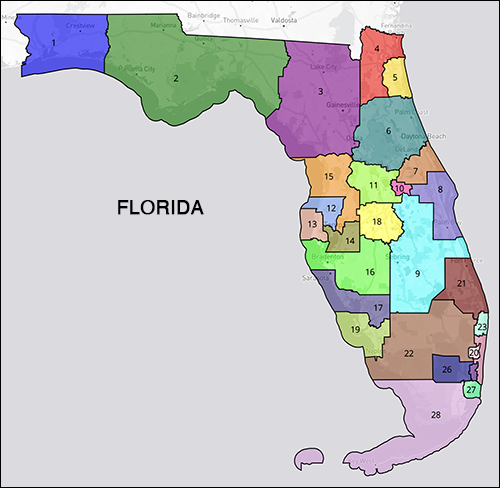
Virginia Congressional Districts map / Dave’s Redistricting App

By Jim Ellis — Thursday, January 29, 2025

Virginia

A Virginia Circuit Court Judge ruled that the legislature violated its own rules in hastily voting to place a partisan redistricting referendum on a statewide special election ballot. Therefore, with this ruling, the Virginia congressional redistricting referendum is likely nullified for the 2026 election cycle.

Judge Jack Hurley Jr. agreed with three of the four plaintiffs’ arguments, which is enough to halt the redistricting process. The arguments largely pertained to legislative procedure for special sessions: determining that the legislators violated certain rules they almost unanimously put in place, and not providing timely notice to voters and counties about the upcoming referendum in accordance with Virginia election law.

The Old Dominion redistricting outcome may have been devastating to Republicans if the proposed map outline, which has not been unveiled publicly, ultimately delivered a 10D-1R partisan split as reported. The current Virginia delegation is 6D-5R. Unless something changes on the legal front in relation to appealing this decision, the 2026 election will be conducted on the present 2021 map.

The Virginia candidate filing deadline is April 2 for the June 16 primary election. Therefore, the 2026 political clock at least regarding redistricting is now on the Republicans’ side.

Yet, even under the current map, several seats will be hotly contested in the midterm election cycle. Eleven Democrats have announced their challenge to veteran 1st District Rep. Rob Wittman (R-Montrose). Former Congresswoman Elaine Luria (D) is mounting a comeback attempt against the woman who unseated her in 2022, Rep. Jen Kiggans (R-Virginia Beach), in District 2.

Moving to the central part of the state, freshman Rep. John McGuire (R-Manakin-Sabot) faces a primary challenge from former Congressman Bob Good in a rematch from the 2024 primary, and general election competition from ex-Congressman Tom Perriello (D), assuming he tops seven other Democrats also vying for the party nomination.

Moving into Northern Virginia, state Sen. Tara Durant (R-Fredericksburg) is poised to run a competitive campaign against freshman Rep. Eugene Vindman (D-Dale City) in the politically marginal 7th District.

Regardless of the electoral map, Old Dominion voters can expect a very active 2026 congressional political cycle.

FL-16

Ten-term Florida Rep. Vern Buchanan (R-Sarasota) announced that he will not seek re-election later this year. The Buchanan retirement means that 55 US House seats are open for the next election. The number includes the four seats that are vacant due to death of an incumbent or resignation from the House and will be filled in special elections.

Of the 55, Rep. Buchanan joins 18 other members who are retiring from elective politics. The others, excluding the two deceased members, are running for another office, either Governor or US Senate. Of the 55 open seats, a total of 30 come from the Republican aisle compared to 20 who are Democrats. The remaining five are new open seats created through 2025 redistricting maps in California and Texas.

Buchanan’s 16th Congressional District, anchored in Bradenton and Manatee County, is safely Republican. The district also houses 25 percent of Hillsborough County. The other population centers are the cities of Bloomingdale, Sun City Center, and Palmetto.

According to the Dave’s Redistricting App statisticians, the Republicans hold the partisan lean advantage at 55.2R – 42.7D. President Trump carried the 16th with a 57.3 – 41.8 percent vote spread in 2024.

It is likely, however, that all of these numbers will change if the legislature follows through and passes redistricting legislation later in the year. Gov. Ron DeSantis (R) says he will call the legislature into special session in April for the purpose of redrawing the congressional boundaries.

Rep. Buchanan is the third member of the Florida delegation to not seek re-election. The other two are Reps. Neal Dunn (R-Panama City) who is retiring, and Byron Donalds (R-Naples) a gubernatorial candidate.

Expect the new 16th District to be slightly less Republican, as will the surrounding seats on Florida’s Gulf Coast. Doing so will allow more Republican voters to be drawn into Democratic seats, and particularly the district of Rep. Jared Moskowitz (D-Parkland) who is clearly in the most vulnerable political position of any central/southern Florida Democratic member.

Nebraska Senate: Here We Go Again

By Jim Ellis — Wednesday, January 28, 2026

Senate

In every US Senate election cycle, it seems that a surprising race unexpectedly comes to national prominence, and one 2026 such campaign is already emerging.

Nebraska US Senate candidate Dan Osborn

Nebraska US Senate candidate Dan Osborn

In 2024, Independent Dan Osborn came from nowhere to battle Nebraska Sen. Deb Fischer (R), and for a long while it appeared he was close to pulling the upset of the year. In the end, Sen. Fischer won by six percentage points, and the Osborn surge fell short.

The chief reason that Osborn, as an Independent, became a competitive threat was because the Nebraska Democratic Party agreed not to field their own candidate and the Democratic state convention delegates then endorsed the Osborn campaign. Serious national fundraising then caught fire.

Osborn’s original reported choice for the 2026 election cycle was to run in the highly competitive 2nd Congressional District, now an open seat with Rep. Don Bacon’s (R-Papillion/Omaha) retirement; but, the Democratic leadership would not commit to supporting him. The reason is simple: The eventual Democratic nominee has a strong chance of winning the seat. The state party leaders said, however, they would again support an Osborn Senate bid, this time against the state’s other Republican incumbent, Pete Ricketts.

In a poll conducted a month ago but just released this week, we again see Osborn performing very well in a Senate battle. According to the Lake Research Partners ballot test data (Dec. 11-17; 600 likely Nebraska voters; live interview), Sen. Ricketts’ lead is only one percentage point, 48-47.

In the 2024 race, Osborn clearly over-performed in polling. In the 19 polls released publicly during the election year, Osborn led in eight ballot tests, was tied in two, and only trailed Sen. Fischer by an average of 4.3 percentage points in the nine surveys where she held the advantage. The momentum turned Sen. Fischer’s way in the campaign’s closing days.

The question for 2026 is whether the closeness of the 2024 race was an anomaly or is Osborn a true threat to upset Sen. Ricketts? In reality, Osborn winning the statewide tally is still a long shot.

In the 2024 race, though Osborn came relatively close in the final vote (53.2 – 46.5 percent), Sen. Fischer still carried 89 of the state’s 93 counties. Osborn’s strength was obviously in the Omaha metropolitan area and in Lancaster County, which hosts the capital city of Lincoln and is home to the University of Nebraska.

In the 89 counties that she carried, Sen. Fischer recorded 66.4 percent of the vote. In the four counties where she lost, which accounted for 56.3 percent of the total votes counted, she trailed Osborn substantially, 56.7 – 43.0 percent.

Sen. Fischer, however, displayed weakness in the metro areas to a greater extent than the other Republican candidates on the same ballot. Therefore, the Osborn task against Sen. Ricketts will be much more difficult.

In those same four counties, Douglas, Lancaster, Sarpy, and Thurston, Sen. Ricketts pulled 50.1 percent in his special election to fill the balance of resigned Sen. Ben Sasse’s (R) term and carried both Sarpy and Thurston counties. In the 89 Republican counties, Sen. Ricketts recorded 78.7 percent of the vote, a performance 16 percentage points higher than Sen. Fischer’s total.

For his part, President Trump also outpolled Sen. Fischer. In the four counties she lost, President Trump recorded 46.9 percent (also carrying Sarpy and Thurston counties) and topped 75 percent in the 89 Republican counties.

While Osborn will have strong union support, the Nebraska Democratic Party behind him, and the ability to raise funds nationally, Sen. Ricketts, considering his strong 2024 Senate win and his 58.1 percent average vote tally in his two successful gubernatorial campaigns, is a clear favorite for re-election.

It will not be surprising to see closer than expected polling published in the coming months, as we have already seen with this December Lake Research Partners poll, but as we approach election day Sen. Ricketts will very likely pull away to win with a substantial victory margin.

Klobuchar Files Gov. Committee;
Minnesota Senate Poll

By Jim Ellis — Tuesday, January 27, 2026

Governor

Minnesota Sen. Amy Klobuchar (D) / Photo by Gage Skidmore, Flickr

It appears Sen. Amy Klobuchar (D) is moving closer to entering the Minnesota open Governor’s race, and her official announcement could come this week.

Toward the end of last week, Sen. Klobuchar filed a state campaign committee for the purpose of preparing a gubernatorial bid. The act of filing, in and of itself, does not mean an individual is an official candidate, but the prevailing Minnesota political reports suggest that launching her candidacy is imminent.

Since Gov. Tim Walz (D) had announced his intention to seek a third term but then withdrew at the height of publicity over the public assistance program fraud scandal, the potential Democratic candidate field found itself virtually frozen because of Sen. Klobuchar’s likely candidacy.

It is apparent that a Klobuchar entry would virtually seal the party’s gubernatorial nomination so Republican candidate speculation comes to the forefront. Former state Senator and 2022 gubernatorial nominee Scott Jensen is the most likely GOP prospect, and he has confirmed his interest in a potential run.

Other possible Republican candidates are state House Speaker Lisa Demuth (R-Cold Spring), state Rep. Peggy Bennett (R-Albert Lea), state Rep. Kristin Robbins (R-Maple Grove), ex-St. Cloud City Councilman Jeff Johnson, agribusiness company CEO Patrick Knight, and several minor candidates. Regardless of who wins the GOP nomination, Sen. Klobuchar will be rated a heavy favorite to win the governorship. If successful, she would then appoint her own successor to the Senate.

The state’s other Senate seat hosts an open race, too, because incumbent Sen. Tina Smith (D) is retiring. Here, we see a competitive two-way Democratic primary developing between Lt. Gov. Peggy Flanagan and Rep. Angie Craig (D-Prior Lake).

While Rep. Craig has a financial advantage, and we will soon see the updated financial totals on the Federal Election Commission 2025 year-end report, Lt. Gov. Flanagan has the early polling lead.

Poll

A just released Public Policy Polling survey (Jan. 16-17; 976 likely Minnesota Democratic primary voters; live interview & text) finds Flanagan leading Rep. Craig, 40-28 percent.

The follow-up questions show that the Minnesota Democratic base is strongly liberal. When asked whether the respondent would be more or less likely to vote for Rep. Craig if they knew she voted to support the Laken Riley Act “that allows the deportation and detention of undocumented immigrants suspected of a nonviolent crime (PPP wording),” 59 percent responded less likely.

Additionally, 71 percent of those surveyed say they would be less likely to vote for Rep. Craig when knowing that she supported a congressional resolution “that included language expressing gratitude to ICE.”

On the secondary ballot test question, asked after reading the aforementioned responses, the Flanagan lead increases to a heightened 54-22 percent. Therefore, it appears Rep. Craig begins the election year as the underdog.

The Congresswoman’s difficulty factor will likely grow after the Minnesota state endorsing convention, held well before the Aug. 11 primary. Lt. Gov. Flanagan will be favored to win the official party endorsement from the attending convention delegates.

Typically, under Minnesota political tradition, most candidates who lose the endorsement vote end their campaign. It is becoming apparent, however, that Rep. Craig, should she lose, will force a primary campaign.

The state of Minnesota has attracted a great deal of national news attention in the past few weeks, and it appears the domain’s 2026 elections will draw even more.